
...And Justice For Some?
- TrueFace Investigations

- Apr 22, 2021
- 48 min read
Updated: Dec 5, 2021

Welcome to Kev's Crime Corner, the regular articles which explore crime, its hidden causal factors, and the media representations of criminal activity. This week Kev's Crime Corner will be part two of the three-part series looking at the causal reasons for wrongful convictions. This week, we will look at the strategic media representations of a death row inmate and the evidence involved in their claims of innocence. In particular we will explore the forensic linguistic evidence which is largely ignored in the media representations of the case and briefly look at the physical evidence in key areas related to the narrative of the crime.
To do so Kev's Crime Corner will be looking at vital pieces of evidence from the following case:
Darlie Lynn Routier Vs the State of Texas.

This case has been selected due to the public availability of the case evidence and seemingly strategic media representations surrounding the case. We will compare the case evidence available to these strategic representations of that evidence. The interested Kev's Crime Corner reader can, therefore, look up and review the case materials used for this week's article for themselves using the links posted below this article. The media representations of the Routier Vs the State of Texas case can be found on two television shows: On Death Row and The Last Defense. Always be view evidence critically with the media's potential hidden motives in mind.
"If it's on a screen - keep your wits keen!"
Ultimately, an accurate crime reconstruction can only have credibility if the case evidence is examined without personal or political bias and using deductive (as opposed to inductive) logic guided by both the scientific method and established forensic protocols to inform forensic conclusions.

Darlie Routier sentenced to death for the murder of two of her children
The problem is the public have an appetite for emotive or evocative entertainment rather than cold scientific facts of a criminal case. As illustrated with the research studies in the last Kev's Crime Corner article, these media representations can have serious negative consequences on judicial outcomes. This leads us to the strategic media representation of the Routier case: ABC News's The Last Defense series- Darlie Routier. It is this representation which clearly seeks to present the case evidence in a far more strategic manner as this article will illustrate. The author recommends viewing both media representations of the case before or after reading this article.

The death row inmate involved in the case we are about to explore is currently still seeking post-conviction relief, therefore, this forensic examiner must stress clearly to the reader he is not advocating innocence or guilt towards any particular inmate or suspected offender (this is for the courts to decide and nor with it be professionally appropriate the author to do so). The credibility of the media representations towards the case evidence is this forensic analyst's focus. This article, therefore, should be read as an examination of the strategic media representations of the case evidence but from a specialist forensic examiner's perspective.

This forensic analyst would argue that the more public interest towards any potential wrongful conviction case is always a good thing but only if it that same interest is an informed one (i.e. informed by all the relevant physical and behavioural evidence evaluations as well as deductive logic). Asking the right questions, a second time around and assessing the case evidence with the scientific method and forensic protocols will perhaps produce more investigative leads and, therefore, potentially post-conviction relief upon case review.

The focus of this article with be the connections between the forensic linguistic evidence and the crime scene evidence as well as the credibility of the narrative of what occurred occurring to the ABC's "Last Defence" media representation of the case. Now let's begin...
Darlie Lynn Routier Vs the State of Texas:

Case Summary:
For readers completely unaware of the case details the following is a summarised version of the case facts. In 1996 on the 6th of June, a 911 call was made by mother of three Darlie Routier claiming that an unidentified intruder broke into her home in suburban area in Dallas, Texas. She claimed the intruder attacked her and two of her sons while they slept downstairs. Darin Routier, Darlie Routier's husband was apparently sleeping upstairs as was their youngest son. The police, upon investigation of the crime scene suspected Routier herself had murdered two of her three sons: five-year-old Damon Routier and her six-year-old son Devon with a kitchen knife from the offender's home. Routier's six-year-old son Devon sustained four sharp force injuries (stab wounds) and her five-year-old son Devon sustained two incise wounds (cuts) and four stab wounds. The attack took place while her children were sleeping. Upon arriving at the scene, the first responding officer noted that Routier had a neck injury (an incise wound), and what appeared to be a stab wound on her right arm. Routier was arrested and convicted after trial. Her death sentence was for the murder of her son Damon (although it is generally understood that her conviction entails responsibility for both murders). She is currently on death row awaiting execution by lethal injection.

With this case summery in mind, Kev's Crime Corner will now begin by exploring elements of the suggested victimology of the case. The "Last Defence” begins by representing the Routiers as a successful ideal suburban American family "enjoying life". Kev's Crime Corner readers will should take note that the interviewees are (with the exception of the contributions by the prosecution attorneys) are chiefly close friends of Darlie Routier, ABC News employees, Darlie Routier's defence team, or local Texas reporters who wrote about the case at the time of the offence. The bias and media agenda are obvious and as Kev's Crime Corner readers will see the objectivity of forensic evidence takes a backseat to the emotive media representations of an ideal carefree family living the American dream destroyed by a mysterious violent offender still at large. What the evidence suggests is quite the opposite...

In news coverage of violent crimes, the media frequently use what in forensic victimology is referred to as "victim deification" to evoke sympathy and ultimately, public outrage towards the media's reported offender. In many cases these victim deifications often obscure both alternative suspects and hidden problems or vices of victims which can reveal important facts about the victims or those close to them. For example, Barbara Jovell (a close friend of Routier's) stated in court that Routier was suffering with depression, was frustrated with the responsibilities of motherhood and had frequent interpersonal conflict with her husband Darin. These factors had apparently reach the point where Routier was seriously contemplating suicide:
Q: Did she tell you why she was about to commit suicide?
Jovell: Because things were getting to her. Sometimes she feels like everybody expected too much of her, and the children were sometimes too much. And she just feels like she wants to end it all. Darlie was nervous and depressed and she fought with Darin a lot.
Router's personal Journal entries reveal that Routier was indeed suicidal even before her third son was born:

September 7, 1995
Devon and Damon are growing so fast, and I see myself getting older each day. I am
now seven months pregnant and we’re bringing Drake Routier into the world…I
have had two dreams about death in the past several months. Both times I was hesitant
to go, but when I did it was such a wonderful feeling, one that you cannot describe
and both times I felt I was going to be with the Lord…

May 3rd, 1996
I hope that one day you will forgive me for what I am about to do. My life has been
such a hard fight for a long time, and I just cannot find the strength to keep fighting
anymore. I love you three more than anything else in this world…I don’t want you to
see a miserable person every time you look at me. Your dad loves you all very much
and I know in my heart he will take care of my babies. Please do not hate me or
think in any way that this is your fault. It’s just that I…”
(Darlie Routier, Sec. 4910-4911)

These journal abstracts (amongst others) illustrate the stark contrast between the ABC "Last Defence" misrepresentations of the Routier's as happy suburban American family. This is equally relevant because the trial transcripts also reveal that Darlie Routier was notably upset the day before the offence:
Q. How do you know she was upset?
A. She was going back and forth, and she was upset.
Q. You say going back and forth, are you
talking about walking?
A. Yes, she was pacing back and forth and
she was upset. And I have seen Darlie upset, so I know
that something was wrong.
(Barbara Jovell, Sec. 2618-2619, 2553)

According to court testimonies from the case detectives there was statements made by Routier that inferred the upset observed by Jovell was likely due to an argument between her and her husband Darin Routier.The following is a transcript abstract from the testimony of detective Jimmy Patterson:
Q. Did you ask her to describe what she and her husband had done the evening prior to this incident?
A. Yes, sir.
Q. What did she tell you?
A. She had said that they had had an argument, and that, she said it was not that bad of an argument, and that they had had an argument earlier in the evening. And, they had sat down, and this is when the two boys were laying on the floor, and had already gone to sleep, and they sat down in the den, and talked about it, for a few minutes, about their finances, and that they finally kissed, told each other that they loved each other, and then Darin takes the youngest, the infant child upstairs and goes to bed, and she stays on the couch, or the sofa. (Det. Jimmy Patterson, Sec. 245)
This was later disputed by Darlie Routier:

Darlie: There wasn’t an argument, that’s all been taken out of context. There was not an argument about the boat. There was not an argument about the car. What I was upset about was that a man had called me earlier, and he was very rude and had cussed me out over the phone. My husband’s car was at his shop, and he wanted my husband to come and pick it up, and he was very rude to me, and I was upset.
Mulder: All right. But it was just a normal discussion between you and your husband?
Darlie: Yes sir.
This leads us to the night of the offence itself:

In the "Last Defence" only brief sections of the 911 call are heard. Additionally, claims by ABC News contributor Brad Garrett makes the claim that Darlie Routier's initial police statement has "very little detail": This is also untrue. Kev’s Crime Corner will illustrate the reasons why this is the case…

As readers will likely be aware, this forensic examiner is a qualified forensic linguist and has trained in several methods criminal statement analysis and will provide the reader with some points of interest, which to the untrained eye (or ear), will seem of little evidentiary value. The 911 transcript is actually a highly valuable piece of evidence which can inform investigative interviewing strategies after a suspect has been linked to a 911 call. We will now take a closer detailed look at both the 991-call transcript and link the physical evidence to the forensic linguistic evidence:

A Forensic Linguistic look is highly valuable when looking examining any statements made during the investigative stage.
The most important aspect of this kind of forensic linguistic evidence is that it is the first initial reconstruction narrative provided. As a result if the case involves suspected crime scene staging (as this one does) the first initial 911 transcript can be compared with the first initial statement taken by investigating officers.
Let's explore the forensic linguistic evidence involved in the case...

Before we examine the 911 transcript which is largely glossed over in both media representations of the case, it is important to note that forensic linguistic analysis of 911 calls should chiefly be used to find potential indicators of deception only to inform investigative interviewing strategies when the physical evidence infers some involvement of the person making the call. Ultimately, the suspects narrative and its deceptive markers (if any) must be compared with the forensic findings in order to determine any guilt upon the behalf of any suspect. Only the physical evidence and a forensic reconstruction can determine if a statement is deceptive or not, but the markers of potential deception will likely be found in the statement itself. Now let’s get to it...
The following are excerpts from the complete transcript of 911:
00:00:00 911 Operator #1 "...Rowlett 911...what is your emergency..."
00:01:19 Darlie Routier "...somebody came here...they broke in..."
00:03:27 911 Operator #1 "...ma'am..."
00:05:11 Darlie Routier "...they just stabbed me and my children..."
00:07:16 911 Operator #1 "...what..."
00:08:05 Darlie Routier"...they just stabbed me and my kids...my little boys..."
00:09:24 911 Operator #1 "...who...who did..."
00:11:12 Darlie Routier "...my little boy is dying..."
00:11:25 RADIO ...(unintelligible) clear...
00:13:07 911 Operator #1 "...hang on ...hang on... hang on"
The first thing of relevance here is the introduction of the suggested intruder of the offence. In this case the suggested intruder is introduced using the singular indefinite pronoun "somebody ".Indefinite pronouns are used to describe people or objects without describing who they are or what they are. This type of pronoun is one of the most abstract of all pronouns and are often found in strategic criminal statements. In this context due to being a first introduction of the suggested intruder it is not uncommon and is found in other 911 calls this analyst has analysed at this stage in the call. The benefit of analysing 911 transcripts is that often conversations with other people at the crime scene are often caught on tape. These background utterances can give extra contextual meaning to language being used. For example, later Routier says the following to her former husband:
01:11:28 Darlie Routier: "...I saw them Darin..."
01:12:21 Darin Routier: "...oh my God ...(unintelligible) ...came in here..."
01:14:10 911 Operator #1 ...ma'am ...I need you to calm down and talk to me...
At this stage the offender is still being described as without any detail being both describe here as without sex or given the most basic of individual traits. Linguistically speaking, the use of single indefinite pronouns "they" and "them" ("them " being inflected form of the singular "they ") is serving as an unspecified antecedent to the indefinite single pronoun (i.e. its pro-form) "somebody ". For the Kev's Crime Corner readers with an interest in linguistics this would be referred to as an anaphora.
The question is, however, does the use of a singular indefinite pronoun in this instance imply any strategic communication?

The use of the plural pronoun here is notable because the "they " does not describe an individual offender but multiple offenders (i.e. they). In other words, the use of "they " is usually plural. "They " also arguably has more conspiratorial connotation in this instant and can in certain instances be used to increase the perception of victimisation due to the individual describing themselves through what some Critical Discourse Analysts refer to as passivation (i.e. describing a person as a passive social actor subjected to more dominant forces within a clause, Van Leeuwan, 2008). Singular uses of indefinite pronouns, however, are well established and are not uncommon in daily use. The lexical choice made here to initially describe the offender, therefore, may not be as strategic as it first appears here. The reason indefinite pronoun usage is considered potentially strategic is that one of their linguistic functions is to replace nouns and are by nature extremely abstract and frequently are found in statements which conceal events, identities of offenders, etc. The lexical verb "stabbed" is also notable because the evidence of the superficial nature of Routier's wounds is clear.

What else did Darlie Routier say during the 911 call?
In order to determine if the use of indefinite pronouns might be strategic or not it is often important to note if there is any shift to other types of pronouns and also note when this shift occurs within a statement:
04:51:29 Darlie Routier ...why would they do this...
04:53:08 Darlie Routier ...I'm (unintelligible)...
04:54:07 911 Operator #1 ...ok ...listen ma'am ...need to ...need to let the officers in the front door ...ok...
04:59:11 Darlie Routier ...what...
05:00:04 911 Operator #1 ...ma’am...
05:00:22 Darlie Routier...what ...what...
05:01:15 911 Operator #1 ...need to let the police officers in the front door...
05:04:21 Darlie Routier ...(unintelligible) his knife was lying over there, and I already picked it up...
05:08:19 911 Operator #1 ...ok ...it's alright ...it's ok...
05:09:20 Darlie Routier: "...God ...I bet if we could have gotten the prints maybe ...maybe..."
This part of the 911 call is vitally important for several reasons: The most obvious reason being that Darlie Routier is at this point not describing or expressing concerns with her two seriously injured potentially dying children but instead has taken on the role as an adjunct detective asking both questions of potential motive which her suggested offender has and additionally giving reasons for the secondary forensic transfers which may implicate her as a suspect. The plural pronoun "we" is also being used here to infer a joint motive and suggest collaborative effort with the police. This occurs at the point which the pronouns shift from abstract singular indefinite pronouns of "they" and " them " to the third person pronoun "his ". This utterance was also notably made just moments before the first responding police officers were about to enter the crime scene and discover the knife with her fingerprints. The pronoun change here is significant additionally because it is also possessive. The ownership of the knife is, therefore, given to Routier's suggested unknown intruder thus linguistically distancing Routier from the murder weapon she claimed she just touched. This is also relevant because the knife being described was actually owned by Routier and was part of a kitchen knife set found at the primary crime scene. This is one of the pieces of evidence which was used by the prosecution to support arguments towards Routier's guilt. In ABC News's "the Last defence" episode there is, however, an inference made that Routier only stated she had touched the knife because she was linguistically primed to do so with a question from the dispatcher:
Skip Hollandsworth, a writer for Texas monthly (now a screen writer) with no forensic or investigative training clearly tries to obscure the linguistic evidence...

During "The Last Defence" episode Hollandsworth says the following:
"When Darlie talks about grabbing the knife... it just sounds suspicious...like she is trying to cover for herself...but the question is...did someone ask her a question about that knife? ...And that's a mystery."
Let's cover the obvious here. The 911 call is recorded. There is no mystery to be solved regarding if someone asked Darlie Routier a question about touching the knife. This is clearly an attempt to obscure the case evidence and make the case itself more mysterious. We have the 911 transcript and the audio as logged forensic evidence. No question about a knife is asked. The dispatcher advises Routier not touch anything. She does not ask her a question:
04:05:02 Darlie Routier ...ya'll look out in the garage ...look out in the garage ...they left a knife laying
on…
04:08:21 RADIO ...(unintelligible)...
04:09:19 911 Operator #1 ...there's a knife ...don't touch anything...
04:11:18 Darlie Routier ...I already touched it and picked it up...
What is being inferred here is that cognitive linguistic phenomena known as "lexical priming" has caused Darlie Routier to innocently answer a question about the knife. This is highly misleading:

The real question here is: was the heavy emphasis on fingerprints and the offender's suggested actions out of place given the urgent circumstances?
In order to understand if the mention of the knife and fingerprints was likely strategic it is necessary to understand the amount of utterances which are out of place made during the urgent circumstances in which they took place. The timing in which they were said the utterance is also relevant. In linguistic terms, overlexicalization occurs when the speaker or written wishes to add emphasis to a certain aspect of their narrative but in the attempt to convince the lister or reader of the importance of this narrative element they seek to overemphasise (Teo, 2000). "The Last Defence" episode attempts to convince the public that Routier only pointed out that she only touched the murder weapon due to a question by the 911 dispatcher, however, the seemingly excessive need to describe the actions of the suggested offender where not only out of place in the context of the 911 call but also when the first responding officer arrived on the scene to assist the Routier's:

The following is a court transcript from the case involving testimony from the first responding officer at the crime scene, officer David Waddell. Here officer Waddell is asked about Damon Routier's ability to speak and Darlie Routier's ability to help her dying son:
Q. Was he making any sort of noise? A. Yes, he was.
Q. And what sort of noise was he making? A. Like a gasping-type noise.
Q. Okay. So, this child -- this child was not dead at this point, was he? A. No.
Q. What did you do then?
A. I instructed her to get some towels and put them on his back to try to stop the bleeding.
Q. And, what did she do? A. Nothing. She kept telling me that when she chased the suspect across the kitchen, that he had dropped the knife by the utility -- somewhere over here in this area, and that she had picked up the knife and brought it back and set it on the counter. And she told me that she thought she had messed up the fingerprints.
Q. Well, at the time, Officer Waddell, that you asked her again to care for this child overhere, this child with his eyes open? Did you feel that she was capable of rendering assistance to this child?
A. Yes, sir.
Q. Okay. Why do you think that she was capable of assisting this child?
A. Well, she appeared to know everything that was going on inside the house. She was real alert and able to tell me what had happened. I thought if she was worried about fingerprints on a knife, she could certainly take care of her kids.
Returning to the forensic linguistic analysis 911 call, we also observe the way in which the knife was introduced was also problematic and there are notable shifts pronouns at that time:

Routier in another ABC interview claims picking up the knife was "like an instinct".
In particular, the use of the indefinite pronoun use made during the 911 call becomes more questionable once the police are heard on the 911 call. It is at this point the there is two notable switches which infer strategic use of language is in fact being used:
03:44:05 911 Operator #1 ...you don't know who did this...
03:45:19 Police Officer ...look for a rag...
03:46:11 Darlie Routier ...they killed our babies...
03:48:03 Police Officer ...lay down ...ok ...just sit down ...(unintelligible)
03:51:11 911 Operator #1 ...(sounds of typing on computer keyboard)...
03:52:13 Darlie Routier ...no ...he ran out ...uh ...they ran out in the garage ...I was sleeping...
03:54:09 911 Operator #1 ...(unintelligible)...
03:56:19 Darlie Routier ...my babies over here already cut ...can I (unintelligible)...
03:59:29 Darin Routier ...(unintelligible) phone is right there...
04:01:28 Darlie Routier ...(unintelligible)...
04:03:01 RADIO ...(unintelligible)...
04:05:02 Darlie Routier: ...ya'll look out in the garage ...look out in the garage ...they left a knife laying on…
Here Routier first refers to the suggested unknown intruder using the third person singular pronoun "he " then (for no apparent reason at all) Routier alters to the indefinite pronoun "they" . Given that the third person single pronoun "he " provides the correct meaning according to Routier's own narrative of events, this shift in pronouns has no logical reason to take place. This takes place after a speech disfluency (i.e. "uh"). While such small shifts in language might seem insignificant to the non linguist, it should be remembered that language must follow logical rules of grammar ,syntax, etc in order to be of any communicative or informative use. Archer and Lansley (2015) have noted that changes in language during high stakes situations are indeed potentially very relevant. These researchers highlight several shifts in linguistic behaviour are important to take note of including shifts in pronouns at certain points in recollected narrative and inappropriate concern towards which displaces value towards more personal elements of a narrative towards aspects which manage impressions innocence. Language use is also a cognitive and , therefore, neurological process and alterations of the most fundamental rules of basic language use are indeed significant during the investigative and trial stages of criminal cases. A fundamental example would be, the basic correct functional language use of the articles "a " and "the ". The use of " a " for example, is appropriate when first introducing something into a statement or narrative or is unfamiliar to the person perceiving the described object but not when the object is already introduced or familiar to the person making the statement. For example, " they left a knife laying on…" is notable here because the knife was owned by the Routier family and instantly familiar to Darlie Routier. While some readers might debate the cognitive ability to use the right words under extreme circumstances it should be noted the human brain is more than capable of doing so...

How fast can the human brain select words to form coherent sentences?
Researchers such as Varnell (2013) note that the average rate of speech in general conversation is estimated to be around 150 words per minute, peaking at around 300 words per minute under certain circumstances. This means that the average speaker has the ability to make the cognitive word choices they want to use without difficulty within about 200-400 milliseconds. Thompson (2009) notes research reveals that within 600 milliseconds the human brain can think of a word, apply the recollected correct rules of grammar to it, apply the appropriate emotional phonology required and send electrical signals to the physical mechanisms of the body related speech function to be spoken aloud. Speech disfluencies and incorrect uses of basic functional language are usually only impaired if there is some serious problem with the areas in the left hemisphere of brain which are actively involved in language acquisition. Word selection can also be hindered if there is an increased demand of the cognitive resources which requires more work on the behalf of the prefrontal cortex (Vrija, Mann, and Fisher, 2006). In fact, research has shown that when the anterior prefrontal cortex of the brain is inhibited people actually become better at being deceptive (Karim, Schneider, et al, 2010). The left hemisphere has multiple areas which are seemly designed to constructed sentences as well as facilitate logical narrative construction:

There are several areas in the brain that have been determined to be highly active during language use (Broca's area, Wernicke's area, etc.). The posterior portion of the superior temporal gyrus is related to auditory speech areas.
Research has also shown that creations of false narratives also consume more cognitive resources (Richards and Gross, 2000). Undoubtedly trauma can affect how and what we speak of regarding traumatic events, however, lexical section is still required regardless of urgent circumstances and frequently trauma only effect language acquisition after the event in question has taken place. 911 calls are made ever minute everyday few illustrate linguistically impaired by trauma. Additionally, those suffering from psychological disorders related to trauma such as PTSD generally do not have problems with language acquisition. PTSD sufferers do avoid discussing the elements of there trauma but problems the basic functional lexical selections of language have not been correlated with the condition itself. There are arguably some instances within this 911 call in which singular uses of indefinite pronouns are evident.There is, however, points in which the indefinite pronoun usage is indeed highly strategic:
05:18:08 911 Operator #1 ...ma'am ...hang on ...hang on a second...
05:19:09 Darlie Routier: "...somebody who did it intentionally walked in here and did it Darin...
05:20:19 911 Operator #1 ...82 ...10-9...
05:21:23 RADIO ...(unintelligible)...
05:22:28 911 Operator #1 ...received...
There are clear indicators of strategic communication here. First, the indefinite pronoun is used not only used incorrectly but also strategically with the auxiliary verb (i.e. "did it") giving the desired characteristic to the abstract choice of pronoun. In other words, the indefinite pronoun "somebody" is given characteristic by responsibility of the act being described. Adding the adjective "intentionally" is also highly strategic. The reason for this is simple: it is not necessary to describe the suggested intruder's intent in this instant unless there was a question of responsibility towards the act itself. It is not possible to accidentally break into someone’s home then stab two children and superficially cut the mother of those two children in the middle of the night the exit the scene. The statement of intentionally is, therefore, likely to add emphasis on the responsibility given to the indefinite abstract pronoun "somebody ". The lexical verb "walked" is also notable because this verb arguably reduces the visceral nature of the violent act involved as well as the commitment of the offender (i.e. "somebody ran in here" would be more appropriate).Put another way, walking is a generally a trivial act whereas running conveys more urgency.This lexical verb is, therefore, out of place here. This is also important for two reasons...

1. BecauseRoutier shifts between stating the suggested intruder "ran" and "walked": (03:52:13)"...no ...he ran out ...uh ...they ran out in the garage ...I was sleeping..." (5:19:09) : "...somebody who did it intentionallywalked in here and did it Darin...
2. Because Routier's descriptions of how she first saw and interacted with the offender are inconsistent in both the 911 call and the first written statement:
(01:56:29) Darlie Routier: "...somebody came in while I was sleeping ...me and my little boys were sleeping
downstairs..."
.(02:02:20) Darlie Routier: "...some man ...came in ...stabbed my babies ...stabbed me ...I woke up ...I was fighting ...he ran out through the garage ...threw the knife down ...my babies are dying ...they're dead..."
Here Routier describes her suggested intruder's actions (using verbs) in detail (even the actions he made while she suggests she was sleeping or he out of sight) and additionally makes another noted utterance involving inappropriate pronouns:
"... I was fighting..."
Linguistically, there is a notable problem with this aspect of Routier's statement involving the first interaction with her suggested intruder. "I " is a personal person singular pronoun that reflects only the singular action of one individual. The problem is the verb " fighting" is a joint activity and describes not only the actions of the speaker but also the suggested intruder. In other words, the correct pronoun would be the first-person plural pronoun "we". It is also interesting that Routier also appears to avoid using any plural pronouns such "we " or "us" when describing the joint action of sleeping with her children ("I was sleeping ...me and my little boys were sleeping"). It is perhaps most important to note here that in the first official written police statement made by Routier actually makes no mention at all of fighting her suggested intruder. Nor does Routier actually describe going to sleep the night the offence took place. This is vitally important because this statement should directly reflect the forensic evidence at the crime scene including any medico-legal investigative findings indicating a joint struggle. At this point is of value to take closer look at Darlie Routier's actual physical injuries she sustained as a result of her suggested struggle with the suggested intruder:

Notice: This wound pattern has bruises which have characteristic shape.The faded red bruising to the left interior lower forearm pictured above has what appear to be G or 6 type shaping (there also appears to be characteristic small shaped bruising in the larger circular bruise which also look like letters or numbers) the shapes indicate a specific object caused the blunt force impact which created the bruising. This is not common bruising for a clenched bare hand fist attack unless there are rings with similar patterns on an offender's fingers when attacking the victim. The shapes and size on the arms would also appear in similar shapes and sizes in most cases (sometimes seen in clusters of blunt force wounds).
Interestingly, the shaping and size of Darlie Routier's wounds differ in both shape and size:

The length of the bruising here is likely due to Routier laying down for long enough period of time after the impact causing the blood from the ruptured blood vessels and capillaries to settle into the lower tissues of the arm due to gravity. When a part of the body receives blunt force impact the bruise first chiefly appears red, however, due to the disintegration of the red blood vessels by the process known as hemolysis there is then a breakdown of haemoglobin causing the bruising to change colour as healing begins. The dark blue bruising here is due to the breakdown of haemoglobin into the iron-based pigment hemosiderin. This usually appears about two to four days after the bruising first occurs (unless the victim has some kind of blood disorder, is on blood thinners, anti-coagulants etc.). Bruises that appear darker from the onset of are usually caused by objects with a hard surface as opposed to bare fists indicating stronger material than flesh and bone was used to create the bruise. Kev's Crime readers should, therefore, take note that dark widespread dark bruises such as those seen in these photos are, therefore, not the result of heavier or more violent impact by a stronger offender but rather the level of hemosiderin and the length of time gravity had to draw the blood towards the bottom of the arm itself. The dark colour of the bruising is also ultimately due the iron levels in Routier's body at the time (women typically have excessive amounts often making monthly menstruation longer and more painful, Weinberg, 2010). The bruising on the opposite arm is, however, even more interesting:

The shape of a violent crime victim's bruising is always relevant because the instrument used to make the blunt force impact will often be evident in many cases.Notice the sharp extremely linear bruising on the left interior forearm. This bruising implies the impact was made by (or against) an object with the size and shape. This bruising is not indicative of bare fist blunt force impact (which appears more circular in most cases with the exception of impacts by forearms which generally appear slightly more oval). Nor is this bruising indicative of impact from the blunt edge of the knife handle found at the scene. It should be noted that Routier claims she slept on her left side the night of the offence. This bruising of the left and right arm is also highly excessive for the momentary struggle she later describes, and it should also be considered that the suggested intruder had a knife in one hand making such excessive empty handed striking arguably unnecessary. The wound patterns and shaping of the bruising here are also disconnected from Routier's knife wounds with bruising occurring in different locations. It should additionally be noted that the bruising here is more excessive the knife wounds Routier sustained which is a stark contrast to the lethal stab wounds sustained by her two children. Considering the murderous modus operandi of the suggested intruder this is highly paradoxical. What is even more perplexing is that Routier apparently never actually had any evidence of this excessive bruising or even swelling on the evening of the offence and this was noted by medical personnel who were questioned during trial regarding Routier's excessive bruising:
Shook: And is that something you look for in your examination of her?
Dillawn: Yes. If I saw that on somebody’s arm, I would probably want to x-ray
their arm.
Shook: Any time on the 6th, did you see any evidence of that type of injury to her
right arm?
Dillawn: None at all.
Shook: The 7th?
Dillawn: No
Shook: The 8th?
Dillawn: No.
Shook: Now, if that blunt trauma had occurred on June 6th, about 2:30 in the
morning, 1996, would you have seen evidence of that injury on her right arm, Doctor?
Dillawn: In my opinion, yes. This is a lot of blood, yes.
(Dr. P Dillawn, Sec. 869)
Additional testimonies indicate more evidence that these injuries may have in fact been self inflicted:
Paige Campbell : When I bathed her right arm, I had to move it around. She
never complained of any pain in her arm.
(Nurse Paige Campbell, Sec. 1160)
Jody Cotner : I didn’t see any injury that would cause
that type of bruising. Absolutely, I would have seen evidence of blunt trauma if it
had occurred at 2:30 AM on June 6th.
(Jody Cotner, Sec. 1039)
In the "The Last Defence" episode, however, claims are also made that there is evidence that Darlie Routier grabbed the knife during a strugglewith her suggested intruder and sustained "textbook"examples of defensive wounds:

This forensic examiner firmly disagrees with Dr. Davis for several the simple logical reasons. The most basic reason being that a supposedly half-asleep victim being suddenly awoken during a lethal knife attack being able to grasp a downward plunging or slashing kitchen knife at speed wielded by a suggested heavy-set intruder committed to killing or seriously harming their targeted victims ishighly improbable boarding on outright fantasy:

Notice the blade here is depicted facing upwards and is at a highly unlikely angle of attack. This obscures the level of force the knife would have had in motion because the offender would have to have been standing over Routier sleeping and thus force would be applied in a downward vertical plane of motion. These wounds, however, are highly superficial incise would which means the blade was either grasped in a controlled manner or lightly pulled (or firmly pressed) across the skin just enough to make the wounds appear visible. Little to any force indicating a struggle took place is evident in the photos of Routier's "defensive" wounds.Even a layman without any medico-legal investigation training would be able to see that from the photo below:

Highly superficial incise wounds to Routier's left hand
(Note: Routier slept on her left side).
Kev's Crime Corner readers should also consider the following:if the suggested intruder pulled the knife with any level of force to free the knife once it was supposedly grabbed, the knife would highly likely have left substantially deep cuts into the tissue of the fingers likely leaving permanent damage to the tendons of the hands not superficial wounds such as these.This is because there is very little muscle or fatty tissue to protect the tendons of the fingers.The wounds to Routier's hand are highly superficial to the point of being reminiscent of paper cuts. This is not any way a "textbook" example of credible defensive wounds against the knife.
What is actually a "textbook" example characteristic of defensive wounds? Typically, defence wounds of the hands usually result deep incise wounds or occasionally stab wounds which frequently result in a permanent or serious loss of function to areas of the hand injured.Arguably, the standard textbook on medico-legal investigations isSpitz and Fisher's Medicolegal investigation of Death (Spitz and Diaz, 2020). In this key forensic textbook, the following insights are noted and are highly relevant to this case:
Tendons and major nerves of the hand (and or arms) are typically severed during a knife attack if the victim attempts grasp the blade.
Victims attacked by knife who claim they were attacked while lying down (or on the ground) are often found to also have defensive cuts and stab wounds to the lower extremities caused when the victim uses there legs to defend themselves.
(Spitz and Diaz, 2020, pages 248-252)
In contrast, Kev's Crime Corner readers should consider the following insights on the characteristics of fabricated injuries for crime scene investigation from Parikh's Medicolegal Post-mortem and Forensic Pathology textbook(Murty, 2019):
"Fabricated wounds are often cuts wounds, occasionally stab wounds, and sometimes bruises."
"These injuries are commonly seen over those parts of the body which are easily accessible, such as the top of the head, the forehead, the neck, the outside of the left arm, the front of the left forearm ..."
"The fabricator usually produces only that much injury as he thinks necessary to confirm his story. He is careful to avoid doing any serious harm to himself. The injuries are therefore usually multiple, superficial..."
(Marty, 2019; pages 201-202)
It should be highlighted to Kev's Crime Corner readers that in Routier's various versions of the described struggle that Routier supposedly had with her intruder she indicates she was sleeping when she was in the process of being attacked. This means she would have been lying down when she was supposedly attacked. While it should be stated that not all victims who are attack lying down will have injuries to the lower extremities it should be nonetheless be noted that the wounds a localised. This adds additional importance to where the suggested intruder was suggested to have been postponed. The superficial nature of Routier's wounds where additionally noted by several expert witnesses during trial. The following are testimonies of from both Dr Janis Townsend- Parchment and Dr Alejandro Santos who give far more accurate description of a textbook defensive wound of the hand:
Davis: When you see defensive wounds on the hands, can you describe what they look like?
Townsend-Parchman: The most common thing I see in defensive wounds of the hand is deep incised wounds. Now I’m talking about deep incised wounds. Most go all the way through the skin into the subcutaneous tissue on the fingers and palms, sometimes going through tendons or all the way to the bone.

Shook: Dr. Santos, is this the type of cut that you’d classify as a defensive wound?
Santos: No. Usually they would be larger and deeper.
What about Darlie Routier's the stab wound Routier sustained to the lower arm?

It has been noted that Routier did sustain a stab wound that went as deep as the bone. The fact is this wound is also superficial because the depth of wound was not due to any additional force by the suggested intruder but actually due to where the wound itself is located on the arm. Stab wounds differ from incise wounds due not only to the direction in which the blade was applied to the victim but also the level of force the suggested offender uses to create the injury itself. Stab wounds generally have much more force thus stabs to the arms are likely to puncture the radial artery, the ulnar artery or the radial or ulnar bones of the arm. This is even more likely to occur if the offender is standing over a victim who is lying down adding additional force to the downward stabs the victim is attempting to defend. This wound showed little evidence of a downward stab wound caused by a heavy-set offender intent applying lethal force. This wound went as deep as the bone only due to the location the knife wound was applied on the arm itself. The area in which the injury occurred has little muscle. This was also noted by expert witnesses during trial:
Dr. Dillawn: "The wound on her right arm was to the bone, but the bone at that point is very superficial in the arm. It went through the muscle but there was no fracture."
Now we will examine misrepresentation of Darlie Routier's neck injury:

The "Last Defence" episode contains a highly inaccurate emotive description of Routier's incise wound describing it as a almost stab wound:

Above is Dan Abrams making highly misleading statements about Routier's superficial injuries:
"It seems clear... that despite fact that... she was stabbed...in the neck! ... that investigators were focusing on her...almost...from moment one."
What is actually clear here is that Abrams has no clue about the forensic findings or the facts he claims or is simply trying to evoke controversy towards the case for the sake of ratings. Router was not stabbed in the neck. The only stab wound was to the arm and this was clearly not created by a downward force of any level power otherwise the would of been at least some damage to the bone. The neck wound itself was noted to have healed well within only 8 days of the offence itself. This is evident in the "silly string footage" used by the prosecution to suggest that Darlie Routier was in a state of deep remorse after losing her two sons in a violent attack. The photo below clear shows the wound is healing rapidly due to to its superficial nature causing little discomfort or pain to Routier:

Dr. Janice Townsend-Parchman: "The neck wound was…possibly less than half an inch deep, but it’s hard to say. It is relatively superficial. It didn’t go very deep into her body, and didn’t strike any vital structures."
Dr. Santos: "This wound cut through the skin and fat, but didn’t penetrate the muscle below. That’s a superficial wound."
Dr. Dillawn: "I usually don’t measure the depth. We don’t think in those terms. I would call it a superficial wound."
Dr. Santos: " The shoulder wound went through the skin and into the fat. We just washed it out and closed it. That is a superficial wound as well. It was probably about an inch and a half in length."

If Routier's neck wound was a serious life threatening wound the wound itself would likely have little signs of proliferative healing or remodelling after only 8 days.The footage of the neck wound appears to be within these stages of wound healing. Given the wounds of Darlie Routier are clearly superficial and highly unlikely of being the result of a suggested murderous intruder as her statements, it is now worth Kev's Crime Corner examining some of the crime scene photos. Few of these crime scene photos appear within the ABC "Last Defence" episode and the few that are shown are not examined by any forensic experts. If a struggle occurred the primary crime scene will reflect that struggle. There are claims by the prosecution of crime scene staging which do in fact appear to be warranted:
There are several displaced objects which indicated to investigators crime scene staging. Notice the balancing object below indicating likely low controlled force used to displace it...
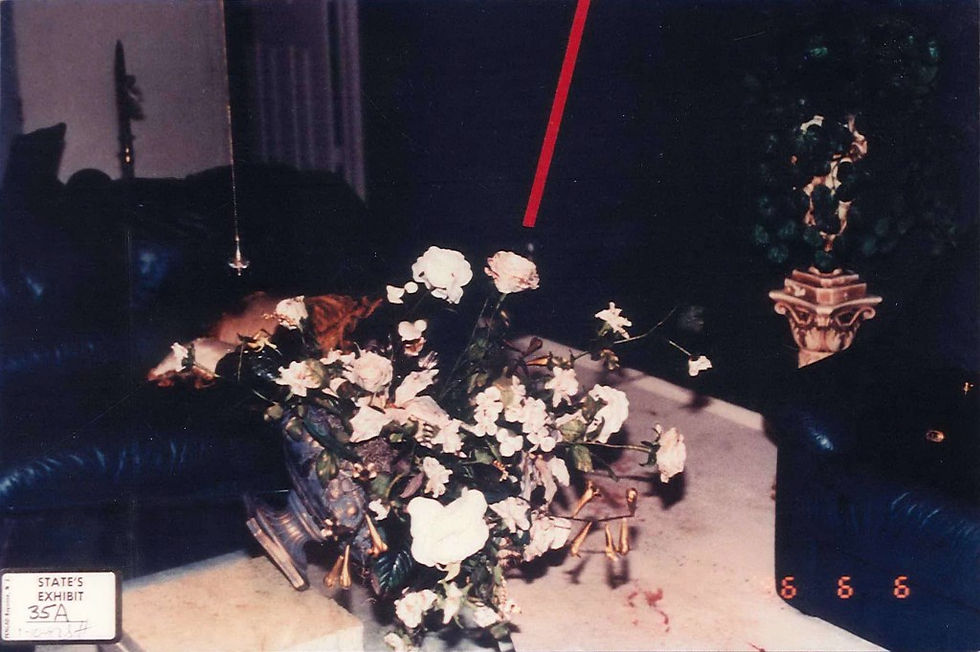
Objects at the scene appear superficially displaced and surrounding objects or furniture underneath the object showing no movement at all to infer an actual impact from a violent struggle.

The living room area where Routier claims an intruder stabbed her two sons then attacked her. Kev's Crime Corner readers should take notice the likely value of the items that are not displaced as well as the manner of placement of the ones that are...

The above is a photo of the couch area where Darlie Routier claims she was attacked. Notice the small space between the furniture would likely further cause two struggling individuals not only to leave more cast off blood transfers on the surrounding objects but also a much higher chance that more objects would be impacted or broken while the struggle occurred. The primary crime scene clearly has little space to move within at speed:

Above is a crime scene photo of the entrance to the kitchen area. To the top right is a wine rack. This was only one glass broken from the large wine rack in this area of the crime scene (seen one the upper right here). This wine rack was tested for its stability and found to have a structural mechanism which hinders bottles or glass from breaking even under heavy impact:

The living room a kitchen area where Routier states she was attacked and pursued her intruder is very relevant for the reconstruction also because the relationships between objects or items of furniture will confirm or deny the suggested narrative.Of particular importance are those items or objects located where a struggle is claimed to have occurred. This is especially true when blood has been shed and the potential victim has indicated self-inflicted wounds:the relationships between objects or items of furniture will confirm or deny the suggested narrative. Of particular importance are those items or objects located where a struggle is claimed to have occurred. This is especially true when blood has been shed and the potential victim has indicated self-inflicted wounds:Of particular importance are those items or objects located where a struggle is claimed to have occurred. This is especially true when blood has been shed and the potential victim has indicated self-inflicted wounds:the relationships between objects or items of furniture will confirm or deny the suggested narrative. Of particular importance are those items or objects located where a struggle is claimed to have occurred. This is especially true when blood has been shed and the potential victim has indicated self-inflicted wounds:
The knife used in the attack would also certainly be dripping with Damon and Devon's blood leaving passive drops on the couch as he made the cut to Routier's neck:

Notice that the sharp edged or corners of objects at the crime scene are likely to have been impacted during a struggle in such a small area leaving trace evidence...

If a struggle occurred in this area there would be both 90 degree passive drops as well as elongated passive drops from the knife which wound impacted on the leather. Projected bloodstains (in this case cast off patterns) would also likely be present due to router's wounds and these intern would that impacted at different angles during the suggested struggle. None appear present in these crime scene photos of the area of suggested struggle seen by this forensic examiner:

Darlie Routier's clothing with noted back spatter and cast-off bloodstains found to be the blood of Devon and Damon Routier. It was the cast-off blood stains which were found on the back of Routier's clothing which the prosecution used to forensically argue Routier's guilt.

Given that the 911 call is brief and spoken language requires quicker response due to verbal interaction, it is of value to now explore the first official written statement by Darlie Routier which, due to being written at both a later time and allows more time to construct, will likely more detailed and of even more value when reconstructions of the offence are made.
The following is from the actual written police statement in question at the point when Darin Routier retires to bed and the suggested intruder is introduced:
" This was around 12:30 or 1:00, I'm not sure. He kissed me and said he loved me, and I told him I loved him and I would see him in the morning. After a while, I started to get sleepy the next thing I woke up and feel a pressure on me.I felt Damon press on my right shoulder and heard him cry, this made me really come awake realised there was a man standing down at my feet walking away from me.I walked after himand heard glass breaking. I got half way through the kitchen and turned back and run to turn on the light, I ran back toward the utility room and realised there was a big white handled knife lying on the floor, it was then I realised I had blood all over me and I grabbed the knife thinking he was in the garage".

The knife at the primary crime scene.
Here Darlie Routier's written statement has several notable areas of which indicate a potential lack of credibility which should be considered. First, there is no mention at all of any struggle with Routier's suggested intruder. Second, there are two areas which have temporal lacuna. First linguistically expressed as "After a while", a temporal lacuna is a missing or abstract piece of a statement which indicates missing time or absent described activity. Sometimes referred to as a "text bridge" because the temporal lacuna makes a bridge in the text between one time that has been described and another. "After a while", therefore, indicates a period of time which has been potentially concealed. "After a while" is also arguably a formulaic sequence of language (i.e. a set phrase of language frequently used in a heuristic manner). Larner (2019) has noted formulaic language sequences are often found in deceptive statements because the sequence is spoken and cognitively stored holistically reducing cognitive demands on the deceiver and making construction of false narratives easier. What also should be noted is that Routier states she started to get sleepy but does not actually describe falling to sleep. It is always important in both forensic linguistics and statement analysis that focus is given to both what the suspect or offence did say or did not say implicitly. The second temporal lacuna is "the next thing...". This arguably infers that Routier fell asleep, but this formulaic phrase is actually a common method of editing a sentence by again concealing or removing time and activity.If the suspect or does offender does not state, they did something an investigator should never assume that they did. Any implicature must be investigated further using investigative interviewing techniques. Kev's Crime Corner readers might also consider the time and distance it would take to travel through the crime scene in the manner described in the statement:
Routier' states she walked after her intruder then ran back to turn on the light before running back towards the utility room...

Excessive descriptions of movement within a suspect's written statement often reveal that time is being linguistically extended in certain areas thus indicating potential exaggeration of the timeline. Additionally, the more variations of movement made by bloodied victims or offenders at a crime scene the more the transfer evidence will reveal the nature of such movements made at the crime scene,
The blood patterns found at the crime scene will also reflect how many people where likely at the crime scene:

D.N.A. map indicating the origins of the blood traces found at the primary crime scene
It’s should also be pointed out that the suggested intruder is additionally being described by Routier as doing two opposing physical actions the first time Routier claims she saw her intruder:
"(missing pronoun) realised there was a man standing down at my feet walking away from me. I walked after him and heard glass breaking."
Here the intruder is paradoxically described as both standing still observing her dying son wake her and at the same time walking in the opposite direction. The paradoxical opposition of the lexical verbs "standing" and "walking away" are obvious but perhaps the most interesting aspect of the verb choice here is that both the suggested intruder and Routier are described as initially "walking ". In addition to no mention of any surprise, shock or fear at finding a knife wielding intruder standing (and simultaneously walking away) over her in the middle of the night after hearing her son crying, the verb "walked" is both none urgent and is inconsistent with Routier's alternative claims that she fought her suggested intruder. It is extremely important to note that Routier does not write anything of the fight she claims she had during the 911 call. This decreases the level of credibility towards Routier's narrative. The verbs indicate the paradoxical illogical version of events. Unless of course, Routier fought the suggested intruder, he then suddenly stopped and then walked away, and she intern walked after him (which is both highly improbable and illogical). Again, all these statements made by Routier should also be compared to the blood patterns and other physical evidence found at the crime scene.
The defence for Darlie Routier attempted to show that there were bloody footprints not belonging to Routier found at the scene using a pseudo-overlay to suggest an intruder was at the scene:

Below is the actual blood stain without the pseudo shoe print overlay.

Note the pseudo shoe prints are almost depicting the intruder walking as if on a tightrope: This would require the suggested intruder to slow down and perform an unnatural movement if this pseudo overlay has any reality (which is unlikely to the extreme). This pseudo overlay pattern would also due to the shoe grip design almost certainly pick up more blood making additional shoe prints easier to detect. Additionally, the only other footprints found were on the first floor where the suggested offender was never suggested to be by Routier and belonged to Darin Routier (likely due to secondary transfers). Kev's Crime Corner readers should take note transfers of blood (especially footprints) will also diminish in intensity as the person or object making the transfer get further away from the original source of blood. If these were the suggested offender's bloody shoe prints there would be an actual trail of more tangible bloody shoe prints from the living room to the cut screen door. This pseudo-overly is another example, therefore, of misrepresented evidence. If this shoeprint pattern were a genuine blood transfer made by Routier's suggested offender, then there would again be a drip trail not an isolated transfer pattern. Below is a close up of one of many the contract transfers which was the only set of discernible bloody footprints found at the crime scene:
Darlie Routier's blood footprint:

In her statement Routier clearly states she heard glass breaking before she got "half way through the kitchen" the problem is that the broken glass and blood patterns found in the kitchen indicates this could not have occurred. Notice the blood 90 degree drops that is within the arch of the left footprint:

The shattered glass above the contract transfers (bloody footprints) here could only have fallen after these bloody footprints were made (any other explanation would be against the basic principles of cause and effect). What should also be notice in the picture above is that there several passive drops in the bloody footprint itself which are clearly undisturbed. This further indicates that these passive drops where either dry when the footprint was made by Routier or that the drops where made after the blood footprint where made. This is further sequence evidence which suggests staging and again calls into question both the timeline and the narrative of Darlie Routier:

The above is a crime scene photo of the utility room which Routier's intruder was suggested to have fled. To the untrained eye this bloodstain pattern above might appear to be what blood pattern analysts would refer to as a drip trail, however, this bloodstain pattern actually clearly indicates a low velocity impact pattern made by passive blood droplets that where falling mainly at 90 degree angles. These passive blood drops were under only the influence of gravity not any kinetic moving force. This is evidence of a standing offender not a moving one:
This bloodstain pattern is , therefore, a pattern of drip stains not a drip trail.
Blood traveling from a moving individual (or object) leaves very different bloodstains than the ones evident in this photo such as blood drops which impact at a 10-degree angle which would be elongated and would have a blood drops tail.The smaller drops indicate blood drops which fell at short distances and can at times indicate the offender lowered their central body mass or that the blood fell from the offender's clothing that was lower to the ground or object. Drops of blood that impact at higher distances are indicated by the drops larger in diameter. Passive 90-degree bloodstain droplets are evident across the crime scene:

below is a photo from the living room table. Notice passive blood spatter with blood drops with spines and surrounding satellites created by the hard glass surface. There is a short drip pattern here (the longer blood stain with connected drops) indicating both a short sequence of drops caused by slow a small movement (or potentially several drips that fell sequentially along a bloody object or item of clothing above). This caused the passive drops to fall close to each other and merge.

Passive and swear bloodstain patterns found where also discovered underneath the appliance door in the photo. This indicates the actual sequence of events contradicts the suggested timeline by Routier and ABC's "Last Defence" tema. There was also forensic examination of the sink area using luminol which revealed trace evidence of Devon and Damon Routier's blood found in the kitchen area:

Below is a picture of the kitchen sink area after the forensic application of luminol ( chemically know as 3-aminophthalhydrazide):

Kev's Crime Corner readers may be interested to know some details about the chemical reaction which creates the glow in the photo (known as chemiluminescence). The glow is created by the application of luminol to areas where suspected blood has been cleared away to avoid detection or incrimination. The glow itself, like all chemistry is due to the process of oxidation (all elements have set amounts of "oxidation states" which determines the number of chemical bonds each element can form with other elements). The glowing reaction is due to metal ions within the blood itself (from minerals in the human body, which are in fact, metals). In particular, haemoglobin contains iron which due to both is ability to attract oxygen and its high capacity to oxidise rapidly, oxidises the luminol. Kev's Crime Corner readers might take note that this is one of the reasons why Iron is a very dangerous metal to put in the human body outside of trace amounts because without blood loss (the only way to release excess iron) iron will settle in the organs and causes cell destruction and leads to all manner of serious problems including infertility, depression, heart attacks, hepatitis. (Garrison, 2009). Hemolysis (noted in the medico-legal section of this article about Darlie Routier's injuries) is actually a decompartmentalization of iron which leads to red blood cell destruction (Weinberg, 2004). It should also be pointed out that Luminol actually reacts to other metals also such as copper and aluminium which also act as catalysts and can sometimes create false positives when looking from hidden blood stains. The light itself is visible due to the emission of photons after the nitrogen atoms in the luminol are replaced by oxygen atoms causing the release of nitrogen gas. It is this release of photons which is seen:

Common glow sticks are actually illuminated by the luminol reaction.
Luminol is extremely valuable because it can detect hidden bloodstains even better years after a blood stain is made. This lasting effect is again because the iron in the heme (from the haemoglobin in the blood) as time passes converts to methemoglobin and the iron is further oxidised till it takes on a ferric state (Proescher and Moody,1939; Thornton and Maloney, 1985). Returning now to the crime scene we also find blood on the door of the utility room:
Crime scene photo from the door way of the utility room.

The proximity of these drops also indicates the movement (or lack of extreme movement) of the offender or a bloodied object. The blood drops in the back ground would again be considered very low velocity indicating they may have fallen at an angle as opposed to being thrown from a bloody object or fleeing person. The blood in this area belong only to Darlie Routier.
This is makes the forensic linguistic evidence all the more relevant because these bloodstain patterns actually physically illustrate that both the verbs " walking " and " running " were physically absent in the rooms though which Routier's suggested offender was said to escape at speed.
This leads the Kev's Crime Corner reader to the next aspect of the strategic media representation of the Routier case:
The media's reconstruction of the suggested intruder's escape.
In "The Last Defence" episode the findings of crime scene analyst James Cron who claimed staging was indicated at the crime scene were debated. Below are photos of the area of externe and exit suggested to be utilised by Darlie Routier's intruder. Look closely...
The backyard area and window that the intruder was suggested to exited through to escape.

Backyard area from another angle ...

None of the seemingly staged impacted objects had any transfer evidence from a bloodied fleeing intruder nor was there any other transfer evidence outside and only certain objects appeared to have been impacted. The dust on the window was also undisturbed.
The Last defence episode, however, includes a claim regarding Darin Routier having proven years before that a knife wielding blood covered intruder could indeed exit the scene without disturbing surrounding elements of the scene:
Darin Routier attempts to prove that the intruder could enter and leave without leaving much if any transfer evidence...

This is a highly misleading and unscientific reconstruction for numerous reasons. The astute reader will easier spot why this pseudo reconstruction is yet another attempt to fit a biased reconstruction theory on top of the forensic findings rather than forensic findings informing the reconstruction:

The Kev's Crime Corner readers will no doubt have observed that this window does not have the cut screen which was in place when the suggested intruder was entering and exiting the scene. Additionally, the suggested intruded (who was described later by Darlie Routier was heavy set) would have fresh blood on his clothing and his clothing would of undoubtably touched the scene leaving several types of forensic transfers (including potentially hair and fiber evidence) An experience intruder would likely cut a screen horizontally or removed the screen (both easy to achieve). Cutting vertically means the offender had to fit between the gap he cut making quick escape highly problematic and unlikely. The intruder was described as running and , therefore, would have to fit through the cut screen while moving at speed. Given the size of the cut and the suggested intruder being described as heavy set there would also be transfers found to the cut screen. The strategic misrepresentation from "The Last Defense" episode also shows close up images of a wide open window that attempts to support this misrepresentation:

Below is the actual crime scene photos which shows that the room itself was packed with various objects which would make exiting the scene without leaving any trace evidence even more improvable:

Below is a look at the room itself from a different angle:

Note the numerous objects suggested to not to have been impacted in this room by the suggested fleeing intruder with blood on his clothing. Notice the empty dog cage on the right...

So the suggested reconstruction of a fast moving heavy set intruder moving this area leaving no significant trace evidence behind exciting the scene unhindered is indeed highly illogical (to say the least) despite the media representations. The Kev's Crime Corner reader will also note that there is an important lack of foundational logic in Darlie Routier's narrative for the simple following reason:

The cut screen was cut by a bread knife owned by Darlie Routier.This means the suggested intruder would have either have entered some other way but made improvised exit through the cut window screen after discarding the kitchen knife he just used to attack Darlie Routier and her two children and then suddenly take the bread knife from the kitchen while running covered in blood to exit. Since there was no sign of forced entry at any other part of the crime scene we can deduce this did not happen. The time and physic physical activity it would have taken to change from one blade (which could of easily have cut the screen) for another would of extend the time the suggested offender was fleeing through the supposedly unfamiliar crime scene. Put frankly, the suggested intruder's tool of entry was actually secured in the house he is suggested to have broken into to commit the offence. Many aspects of Routier's version of events thus define simple logic but further calls in to question basic the cause and effect which is missing in ABC "The Last Defence" episode:

Over complicated narratives or misdirections of basic cause and effect are often present in cases involving staged crime scenes.
One last strategic misrepresentation by the will now be explored to illustrate just how deceptive the media can be when presenting evidence. This involves the claims of a mysterious vehicle seen by eyewitness before the offence occurred:

In ABC's "The Last Defence" episode there are again several misleading representations involving this mystery vehicle. In the episode it is suggested that several eyewitnesses saw a suspicious black car circling the neighbourhood. A mysterious black car is show moving slowly through the neighbourhood. It is also suggested that this was never fully investigated despite police reports being filed out regarding the vehicle and statements being requested by police:

Two of these eyewitnesses where Halina Czaban and her daughter, Barbara Jovell. Halina Czaban was actually called by the police and was asked to come to the station to make a statement regarding this mystery vehicle. The following reveals the actual reason that Czaban thought this vehicle and its driver was suspicious:
Mosty: When did you see the black car?
Jovell: It passed me by. I was driving.
Mosty: You don’t recall a Hispanic male [get in that car]?
Jovell: No, I only saw the back of the car.
Mosty: You thought that car was suspicious, didn’t you?
Jovell: No. I told mother to, pardon my language, “Quit freaking out, mama.
There’s a lot of black people living in this neighborhood.” Because she said, “Who
is that black man?” when he passed us. And so I looked and I only saw the back of
the car.
(Barbara Jovell, Sec. 2633-2636)
So at least one eyewitness statement raising suspicions about the black vehicle is arguably potentially due to what appears to be potential racial xenophobia. This is perhaps more evident when the following testimony abstract is considered:
Mosty: That it was somebody who was suspicious in the back alley looking in the
Routier’s garage?
Jovell: Not suspicious. It was more of, “Who is that black man and what is he doing
in this neighborhood?” She (referring to Halina) thought black people
don’t have nice neighborhoods.
It should be noticed by Kev's Crime Corner readers that even if a black male in a black vehicle was engaging in criminal activity in the local area at the time this no way implicates that black male to be involved in this offence. The fact is there is no evidence whatsoever (as far as this forensic examiner is aware) that there was any involvement of any black offender involved in this case. In addition, Darlie Routier clearly stated in a later interview that her suggest intruder was a heavy-set white male. The suspicious mystery vehicle and the suggest mystery offender thus appear to more based upon socio-economic differences and inferred racial bias by at least one eyewitness."The Last Defence" reconstructions of the eyewitness evidence appear (yet again) to be another indicator of the media attempting to evoke controversy. The court testimonies are very clear:

It appears Halina Czaban isn't a fan of ice tea. Perhaps she has an unconscious preference for Vanilla Ice instead?
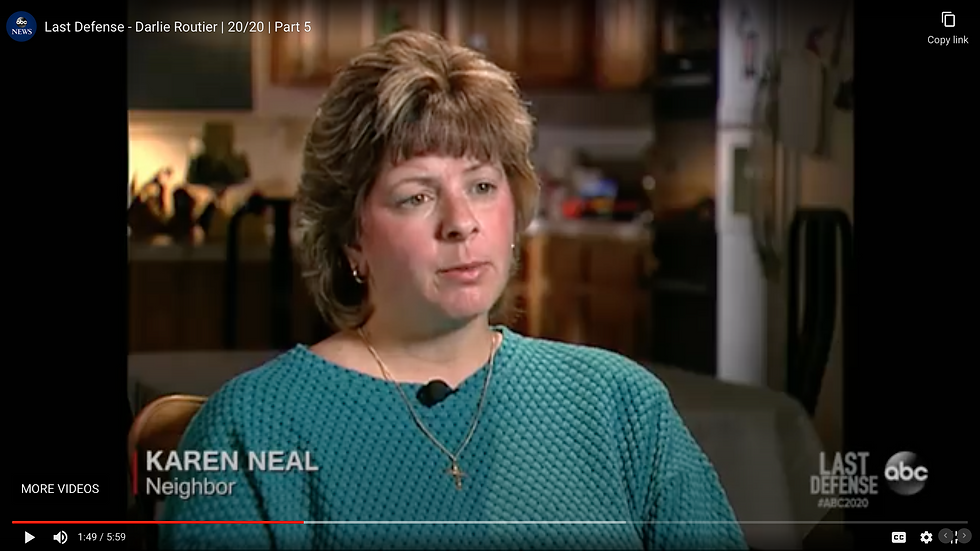
Another eyewitness who was actually featured in "The Last Defence" episode of the case is Karen Neal.Neal (according to court transcripts) saw a black vehicle several times in the month before the homicides. In "The Last Defence", Neal states she once observed this black vehicle and its mysterious occupant watching Darlie Routier's home. This is made to seem even more sinister by ABC News with their fictional reconstruction of Karen Neal's witness testimony giving addition credibility to her vague eyewitness statement:

The fact is eyewitness statements of a black vehicle in the area does not give any credibility to the claims of an intruder committing this offence. The "Last Defence" is actually giving credibility to a well-known logical fallacy know in Latin "as post hoc ergo propter hoc" which in English means "after this, therefore because of this". Put bluntly, after the offence took place eyewitness statements which equated to little more than an unknown vehicle speeding and a black man spotted in a predominately white middle class neighbourhood were given causative meaning to an unrelated violent offence. While clearly one eyewitness statement appears to partially due to racial bias, however, Karen Neal's statements featured in the "Last Defence" episode attempt to suggest someone was watching and, therefore, targeting the Routier home.The court testimony of Karen Neal actually points out that it was common for passing vehicles to stop outside Routier's house to look at the fountain outside the property and it was in fact this what she observed:
Q. How long have you been seeing it in the neighborhood?
A. I would say, maybe, as much as a month
ahead of time. I did not see it daily. I saw it, maybe,
two or three times.
Q. Just driving by?
A. "Including that time, just driving by.
He would slow down. It was not uncommon for people, as
they went around the corner, to slow down and look at the fountain. So I saw him doing that".
This infers that the black vehicle's owner seen by Karen Neal may have simply have been someone passing through the area regularly that month who potentially had appreciation for water fountains. No criminal activity was observed or linked to the owner of this black vehicle nor should any be assumed in any way (let alone double homicide or assault with a deadly weapon). It would not surprise this forensic examiner if ABC News took it upon themselves to further mislead the public further with more misrepresentations of the evidence in this case. Perhaps the next media misrepresentation will make even more elaborate attempts to construct an entire reconstruction theory based upon this misery vehicle. Perhaps appearing even more sinister in the next media representation...

Conclusion:
Media representations of forensic evidence frequently have as much forensic credibility as a Hanna Barbera cartoon but are much more damaging and misleading. ABC News's "Last Defence" production team would have gotten away with it too... if it wasn't for those pesky kids that hang out on Kev's Crime Corner.
The following is a collection of links used for this months article :
References used for this article:
Baskin, D., Sommers, R. Ira , B. (2010). Crime-Show-View Habits and Public Attitudes Toward Forensic Evidence: The "CSI Effect" Revistited". Justice System Journal. Vol 31. Issue 1. Pages 97- 113.
Caddy, B. (2001). Forensic examination of glass and paint. First (ed) Taylor and
Francis, London and New York.
Chase, A (1986). "Lawyers and Popular Culture: A Review of Mass Media Portrayals of American Attorneys". American Bar Foundation Research Journal. 11 (2): 281–300.
Collins, J. M., Jarvis, J. (2009). The wrongful conviction of forensic science. Forensic Science Policy Management: An International Journal. Vol 1: 1. Pages 17- 31.
Curran, J . M., Hick, T. N., Buckleton, J. S. (2000). Forensic Interpretation of Glass Evidence. New York, USA. CRC Press.
Duncan, C. (2019). Justifying Justice: Six Factors of Wrongful Convictions and Their Solutions. Research Journal of Justice Studies and Forensic Science. Vol 7. Article 6 [Online]. Available at: <https://scholarworks.sjsu.edu/themis/vol7/iss1/6> .[Accessed 22 nd, Feb, 2021].
Cole, S. A. (2012) Forensic Science and Wrongful Convictions: From exposer to contributor to corrector. New England Law Review. Vol 46. No 4. Pages 711- 736.
Garrison, C. D. (2009). The Iron Disorders Institute Guide to Hemochromatosis. Sourcebooks, Incorporated, USA.
Gross, S. R. , Shaffer, M. (2012). Exonerations in the United States, 1989-2012. University of Michigan Public Law Working Paper. No 227. Pages 1- 103.
Harpster, T. (2006) The nature of 911 homicide calls: using 911 homicide
calls to identify indicators of innocence and guilt. Bowling Green State University, Bowling Green
Karim, A. A., Schneider, M., Lotze, M., Veit, R., Sausend, P., Braun, C., Birbaumer, N. (2010). The truth about lying: Inhibition of the anterior prefrontal cortex improves deceptive behaviour. Cerebral Cortex. Vol 20: Issue 1. Pages 205-213.
Kim, Y. S., Barak, G; Shelton, D. E (2009). "Examine the "CSI-effect" in cases of circumstantial evidence and eyewitness testimony: Multivariate and path analyses". . Journal of Criminal Justice. 37 (5): 22.
Kloosterman, A., Sjerps, J. M., Quak, A. (2014). Error rates of DNA analysis: Definition, Numbers, Impact and Communication. Forensic Science International Genetics. Vol 12. Pages :77-85
Larner S. (2019) Formulaic Sequences as a Potential Marker of Deception: A Preliminary Investigation. In: Docan-Morgan T. (eds) The Palgrave Handbook of Deceptive Communication. Palsgrave Macmillan, Cham. <https://doi.org/10.1007/978-3-319-96334-1_17>
Lawson, T. F. (2009). Before the verdict and beyond the verdict: The CSI infection modern criminal jury trials. Loyola University Chicago Law Journal. Vol 4. Pages 132- 142.
Logan, S. H. (2021). Guy Paul Morin [Online]. Available at <https://innocencecanada.com/exonerations/guy-paul-morin/> Accessed 21 March 2021].
Proescher, F., Moody, A. M. (1939). Detection of Blood By Means of Chemiluminescence.
J. Lab. and Clin. Med. Vol 24. Pages :1183–1189.
Richards, J. M., Gross, J. J. (2000). Emotion regulation and memory:
The cognitive costs of keeping one’s cool. Journal of Personality and Social Psychology. Vol 79. Pages 410-424.
Selby, D. (2020). Why Bite Mark Evidence Should Never Be Used in Criminal Trials [Online]. Available at < https://innocenceproject.org/what-is-bite-mark-evidence-forensic-science/> .[Accessed 21 March, 2021].
Shroud, M. (2019). The Thin Blue Line: The Failure of High-Tech Policing. New York. Metropolitan Books.
Smit, N. M., Morgan, R. M., Lagnado, D. A. (2018). A systematic analysis of misleading evidence in unsafe rulings in England and Wales. Science and Justice. Vol 58. Pages 128-137.
Saks,
Schweitzer, N. J., Saks, M. J. (2007). The CSI Effect: Popular fiction about forensic science. Jurimetrics. Vol 47. pages 357–64.
Teo, P. (2000). ‘Racism in the news: A Critical Discourse Analysis of News Reporting in Two Australian Newspapers’. Discourse & Society. Page 20.
Thompson, A. (2009). Speed of Thought-to Speech Traced in Brain. [Online]. Available at <https://www.livescience.com/5780-speed-thought-speech-traced-brain.htmlhttps://www.livescience.com/5780-speed-> . [Accessed 25 of March 2021].
Thornton, J.I. and Maloney, R.S. (1985). The Chemistry of the Luminol Reaction—
Where to From Here? Calif. Assoc. Crim. Newsletter , Sept: Pages 9–16.
Tiwari, N., Hershey, A., Das, T., Abhyankar, S., Yadav, V. K., Nigam, K., Ankit, V. R., Srivastava. (2019). Evidential significance of multiple Fracture patterns on glass in forensic ballistics. Egyptian Journal of Forensic Sciences. Vol 9. (1). Pages 9-22.
Van Leeuwen, T. (1996). “The Representations of Social Actors”. In Caldas-Coulthard, C.R. and Coulthard, M. (Eds). Texts and Practices: Readings in Critical Discourse Analysis. London: Routledge. pp 32-70.
Darnell, S. (2013). Statement Analysis: An ISS Course Workbook. SVC Publishing, Apollo Beach, Florida. Pages 45-47.
Vrij, A., Mann, S., Fisher, R. (2006). An empirical test of the Behaviour Analysis Interview. Law and Human Behaviour. Vol 30. Pages 329-345.
Weinburg, E. D. (2004). Exposing The Hidden Dangerous of Iron: What Every Medical Professional Should Know on the Impact of Iron on the Disease Process. Cumberland House, Nashville Tennessee.


Comments